Why Your Brain Won’t Stop Thinking Negative Thoughts | Ep. 27
Do you ever look around at other women who seem to have their shit together and wonder how they managed to get rid of all those negative thoughts?
Meanwhile, your brain is over here running a 24-hour news network of criticism, what-ifs, and worst-case scenarios.
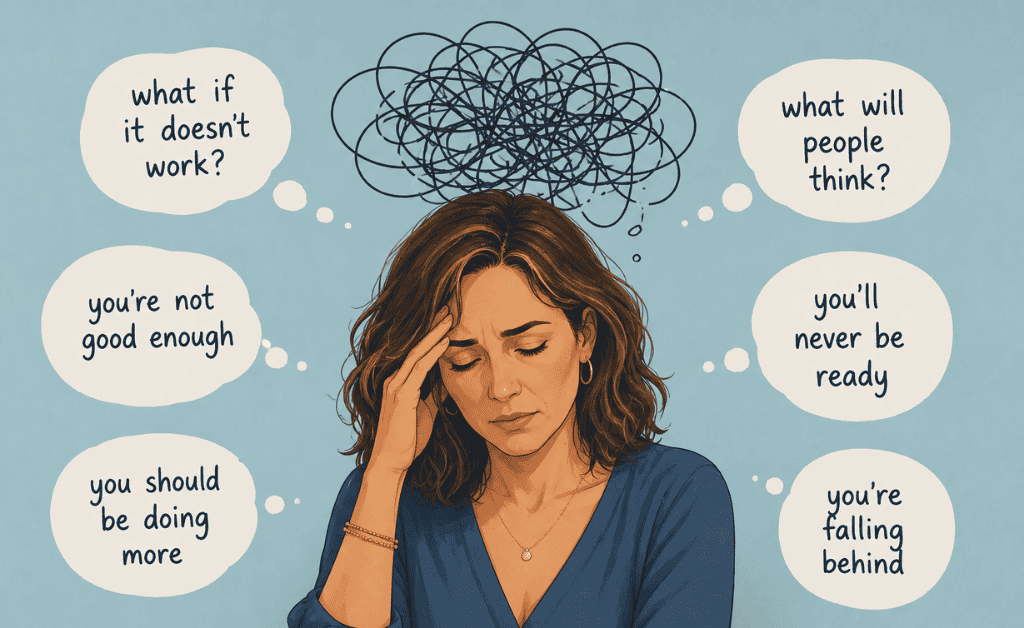
You put on jeans that are tighter than you remember and immediately start criticizing your body. You have an idea for something you’d love to do and your brain jumps in with: You could never do that. What if it doesn’t work? What will people think? Who do you think you are?
Here’s the part I wish we understood better: those women you think have figured out how to stop negative thoughts haven’t. None of us have.
Negative thoughts are part of having a human brain. The goal isn’t to get rid of them. The goal is to stop automatically believing everything they have to say.
You’re Not Supposed to Stop Having Negative Thoughts
I think we tend to believe two things about negative thinking.
First, other people don’t have as many negative thoughts as we do. Surely the woman with the successful business, great marriage, amazing body, fabulous vacations, and beautifully organized pantry isn’t walking around with the same ridiculous shit happening in her head.
She is.
Every badass woman you know has negative thoughts. Every woman who seems to have all her ducks in a row has them. Every wildly successful woman has them.
The second thing we believe is that eventually we’ll evolve our way out of them.
If I do enough personal growth work, criticism won’t bother me anymore.
If I lose the weight, I’ll finally stop criticizing my body.
If I make enough money, I won’t feel like an imposter.
Nope.
You may have different thoughts at the next level, but you’re still going to have them. That doesn’t mean the work isn’t working. It means you still have a human brain.
So if getting rid of negative thoughts isn’t the goal, what the hell are we supposed to do with them?
I like to think of my brain as having four different parts.
It isn’t just your hormones that are changing.
Your relationships are changing. Your priorities are changing. Maybe what you want from your life is changing, too. Take the free Shift Happens™ Quiz to find out where to focus first.
Meet the Four Brains Living in Your Head
Obviously, you do not actually have four brains. This is simply the way I picture the different kinds of thoughts happening in mine.
1. The Helicopter Mom
She loves you. She means well. And she would very much like to wrap you in bubble wrap and make sure you never do anything remotely risky.
She’s the voice saying:
What if it doesn’t work?
What if people judge you?
What if you embarrass yourself?
Maybe we should just stay right here where it’s safe.
This part of your brain is protective. Humans evolved in environments where danger mattered and belonging to the group could literally affect survival. We’re also wired with a negativity bias, meaning negative experiences and information tend to grab more of our attention than positive ones.
Which is incredibly useful if you’re trying not to get eaten by something.
Slightly less useful when you’re thinking about starting a business or posting a Reel.
I experienced this recently after posting a lighthearted video comparing my only child leaving for college to the breakup of an 18-year relationship. Most of the response was lovely. Moms understood exactly what I meant.
A couple of people did not.
Guess which comments my brain wanted to think about for the next several days?
Not the lovely ones.
Even knowing all of this, I caught myself thinking, I shouldn’t let this bother me. I need to work on myself more so things like this don’t affect me.
But that’s the trap. The fact that something negative grabbed my attention didn’t mean I was unusually insecure or failing at thought work.
It meant I was human.
2. The Inner Critic
This one is less loving.
She’s the one who notices the jeans are tight and has quite a lot to say about why.
She critiques your wrinkles. Your body. Your parenting. Your choices. The thing you said yesterday. The thing you haven’t accomplished yet.
She’s basically Miranda Priestly from The Devil Wears Prada mixed with those two old guys in the balcony on The Muppets who criticize everything.
Just ongoing commentary. None of it particularly helpful.
One way I find it easier to deal with both of these voices is to personify them.
There’s actually a reason this can help. Psychological distance allows us to experience a thought as a mental event rather than immediately accepting it as truth.
So instead of:
I’m going to fail.
It becomes:
Oh, there’s Helicopter Mom. She’s worried I’m going to fail.
Or:
There’s my Inner Critic again. She has opinions.
You don’t have to argue with her. You don’t have to make her disappear. You can recognize who’s talking and decide whether you want to listen.
Stop Using Someone Else’s Highlight Reel as Evidence Against Your Life
These two parts of our brains get especially loud when we’re looking at other people.
A perfect example: my family recently spent two weeks in Switzerland.
If you saw my social media, you saw spectacular mountains, gorgeous scenery, beautiful hikes, and happy family photos.
All true.
Here’s what you didn’t see.
Switzerland was having a heat wave, and apparently air conditioning and fans are not a thing they care nearly as much about as Texans do. We were waking up around 3 a.m. because of the time change. My son got sick. I got sick. The food was mostly mediocre and insanely expensive.
And every time we hiked, I was confronted with the fact that I had not gotten myself into nearly good enough shape for this trip.
Then there was one particularly lovely hike with my son.
The first third was spectacular. Beautiful weather. Incredible scenery. We took pictures.
Then I got nauseous.
It got hotter. I got slower. Eventually I literally threw up on the side of the trail and spent the rest of the hike wondering if this damn trail was ever going to end.
You didn’t see those pictures.
The beautiful things I posted weren’t fake. They were just incomplete.
That’s what we forget when we look at somebody else’s marriage, career, family, body, vacation, or life and use what we can see as evidence that they’re doing it right and we’re doing it wrong.
You cannot see the thoughts in those pictures.
You don’t know what happened ten minutes later.
Sometimes she was puking on the side of the trail.
Something On Your Mind?
Have something you can’t stop thinking about—a problem, a decision, a situation, or something you know you want to change? Start with Your Next Move.
The Two Parts of Your Brain You Want to Strengthen
If Helicopter Mom and the Inner Critic aren’t going anywhere, we need another strategy.
That’s where the other two parts of the brain come in.
3. The Creative Brain
This is your curious, adventurous, daydreaming brain.
She wonders what it would be like to take the dance class, start the business, learn to paint, travel somewhere new, or do something completely outside your comfort zone.
She needs space.
Boredom. Quiet. Journaling. Meditation. A walk without your phone or a podcast playing in your ears. Sitting with your coffee and staring out the window for a few minutes.
We spend an awful lot of time filling every available second of our lives with input. Your creative brain needs some room to wander.
4. The Intentional Brain
This is the part that can observe everything else happening up there and decide what you intentionally want to think, believe, and do.
And this brain needs reps.
This is one of the reasons I created the SHIFT Method™.
When something is bothering you, SHIFT helps you separate what actually happened from the enormous story your brain has built around it.
You Separate Fact from Fiction.
You Hear the Story your brain is telling you.
You Identify Who You Want to Be in this situation.
You Find Your Next Mantra.
And then you Take Action.
But there’s another piece I want you to add when you’re hearing your story.
Give the Other Side of the Story Some Airtime
When you brain dump all those thoughts onto paper, let your brain go for it.
Don’t censor the ugly stuff.
Maybe the fact is simply:
My husband doesn’t want to go to Italy.
But your brain has turned that into:
We’ve grown apart. We don’t have the same interests. He doesn’t want to spend time with me. If he loved me, he’d want to go.
Write it all down.
Then deliberately ask yourself:
What else is true?
Maybe you have a strong connection in dozens of other ways. He makes you laugh. You love hanging out together at home. He kisses you every time he leaves the house. He shows you he loves you constantly.
None of that means you have to pretend you don’t want to go to Italy.
You’re simply giving the other evidence some airtime too.
Because your Inner Critic and Helicopter Mom do not need any more strength training.
Those two are jacked.
They’ve basically been running advertisements in your brain for years.
You know how you see an ad for a pair of jeans on social media and initially keep scrolling? Then you see them again. And again. Now someone is showing you how stretchy they are. Then how cute they look dressed up. Then another woman is raving about them.
Eventually you start thinking, Maybe I do need those jeans.
And then you buy the damn jeans.
I did. They are comfortable, but that’s another story.
Your brain works a little like that too. When it repeats the same thought often enough, you start treating it as truth.
So why not intentionally run some better ads?
That’s where your new mantra comes in.
Not some positive-thinking BS you don’t actually believe. Your mantra should be based on real evidence and grounded in who you want to be.
In the Italy example, it could be:
We don’t have to want the same things to have a great life.
That doesn’t make Helicopter Mom or the Inner Critic disappear. It gives your intentional brain something else to practice.
And every time you practice it, you put in another rep.
You Don’t Need a Quieter Brain. You Need a Stronger Other Side.
Picture a tug-of-war.
On one side are Helicopter Mom and your Inner Critic. They’re pulling hard because they’ve been training for this their entire lives.
On the other side are your Creative Brain and your Intentional Brain.
Your job isn’t to somehow kick the first two off the field.
Your job is to strengthen the other side.
Create space for curiosity and possibility. Notice your automatic thoughts without assuming they’re true. Look deliberately for evidence your brain conveniently ignored. Choose thoughts you actually want to practice. Take action that gives you new evidence about yourself.
Then do it again.
And again.
The next time the negative thoughts start popping up like popcorn, you don’t need to make that mean something has gone wrong.
You just need to put in some reps on the other side.
Ready to Put This Into Practice?
If you have something going on in your life right now and your brain has a whole lot to say about it, start with Your Next Move™.
It’s a free guided coaching experience where I’ll walk you through the SHIFT Method™ step by step so you can separate what’s actually happening from the story your brain is telling you, get clear on who you want to be, and decide what you want to do next. This is the specific next step Jody gives listeners at the end of the episode.
About the Author

Hi, I’m Jody Phifer, a Certified Midlife Coach for Women and founder of Thrive With Intention™. I help women thrive through menopause and the midlife transitions nobody warned us about.
Whether you’re navigating changing hormones, an empty nest, shifting relationships, questions about your purpose, or simply don’t feel like yourself anymore, you’ll find honest conversations, practical tools, and coaching to help you confidently decide what comes next.
When I’m not coaching or recording the podcast, you’ll probably find me with a cup of coffee, spending time with my husband and son, or planning my next mountain adventure.
👉Not sure where to start? Take the free Shift Happens™ Quiz or join the Thrive Tribe for practical encouragement and resources for navigating menopause and midlife.